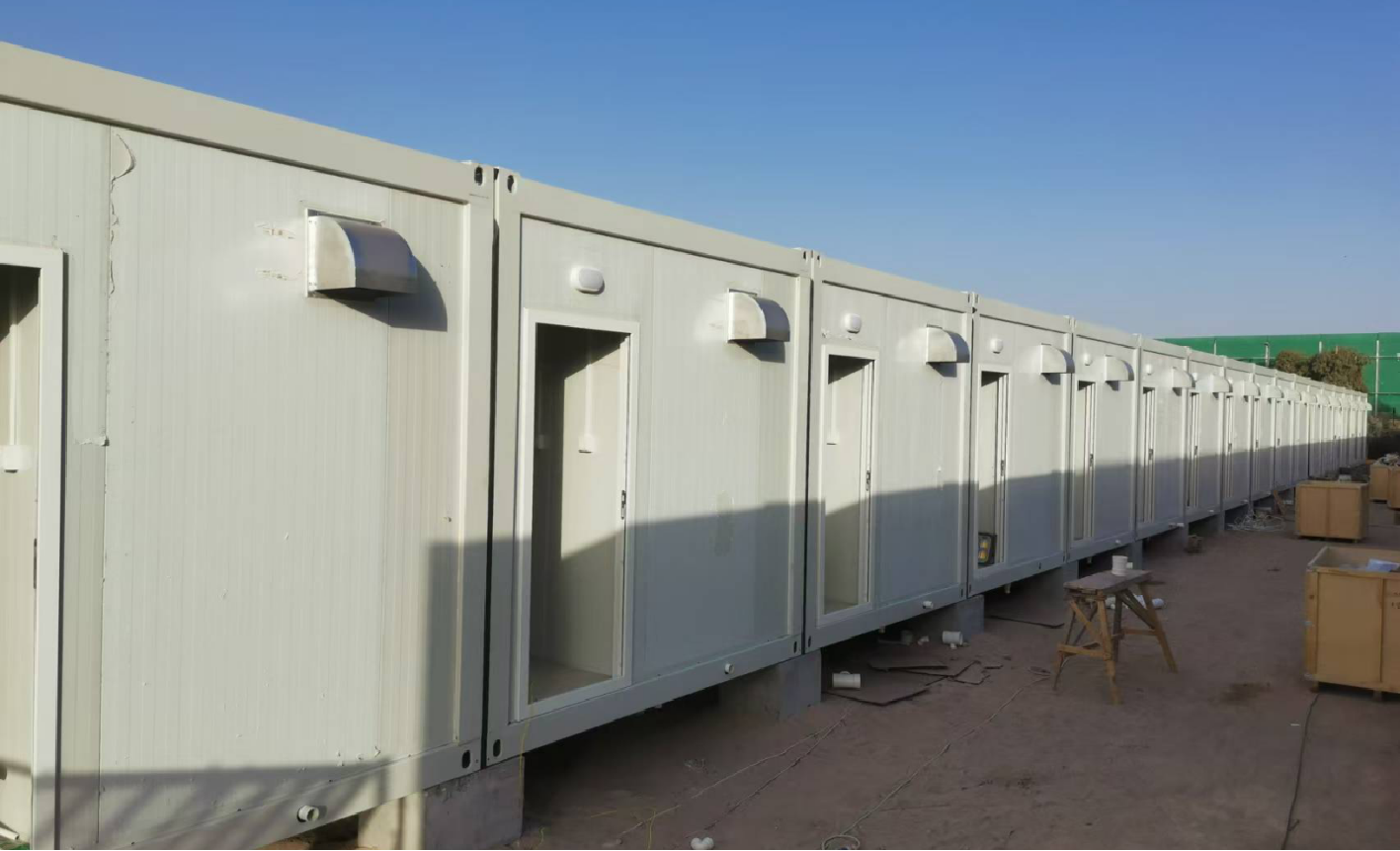
A folding container house is a module whose walls, roof and floor are hinged together so the unit travels folded flat and unfolds on site into a room. The format is promoted on erection speed: a folded unit arrives compact and opens with a small crew. CDPH does not manufacture folding container houses. The CDPH range is built on a bolted steel module supplied as a completed unit, packed flat for transport, or bolted for later demounting. This page explains what the folding format is, what to verify before specifying it from any supplier, and how the CDPH formats answer the same rapid-deployment brief.
What the format is
In a folding unit, the structural envelope is a mechanism: floor and roof panels are connected to the walls by hinges, the unit is folded into a flat pack for transport, and erection consists of unfolding the box and fixing the hinge lines. Because the same joints carry transport handling, erection and the finished building's weather seal, the condition of the hinge lines decides how the building performs — and how it performs after the second or third move.
What to check before specifying one
- Hinge-line structure. Ask how roof and floor loads cross the hinge lines in the erected state, and request the design load table for the unfolded building.
- Fold cycle rating. If the unit will be folded and moved repeatedly, ask how many fold cycles the hinges and seals are rated for, and what inspection is required between moves.
- Sealing after unfolding. The hinge lines are also the weather line. Ask how they are sealed on each erection and whether sealing is a factory or a site operation.
- Fire and compliance evidence. Request test evidence for the complete unfolded unit, for the market the building will be used in.
- Erection requirements. Confirm crew size, lifting equipment and fixing time per unit, so programme comparisons against assembled formats are made on the same basis.
The CDPH alternative: flat pack or complete modules
CDPH answers the rapid-deployment brief in two ways, neither of which depends on hinges. The flat pack container house ships the standard 6055 mm module packed flat and assembles it on site with bolted connections — compact transport, with assembly labour instead of a folding mechanism. Where site time matters more than freight volume, standard modules are delivered as completed units with walls, flooring and services fitted in the factory, and bolted together on site. Both formats use the same galvanised cold-formed steel frame (t=3.0 mm, SGH340), 100 mm glass wool roof and floor insulation, and design loads of 1.0 / 0.5 kN/m² roof live load, 2.0 kN/m² floor live load and 0.6 / 0.5 kN/m² wind load; the detachable format adds demountability for camps that will be taken apart and reused. Emergency and temporary programmes are compared in our emergency temporary housing guide.
Folding format vs CDPH formats
| Question | Folding unit (wider market) | CDPH bolted module |
|---|---|---|
| How the unit travels | Folded flat on its own hinges | Flat pack format packed flat, or completed module |
| Site operation | Unfold and fix hinge lines | Assemble panels (flat pack) or bolt modules together |
| Repeated moves | Governed by hinge and seal cycle rating | Unbolt, transport, re-erect |
| Weather line | Hinge lines double as seals | Fixed panel joints, bolted connections |
| Evidence to request | Loads and fire evidence for the unfolded configuration | Module load table and category certifications |
Talk to CDPH about the brief behind the format
Most folding specifications are really a requirement for fast occupancy or compact freight. Send your occupancy date, unit count and transport route to the CDPH engineering team; every project is quoted individually after engineering review — there is no standard MOQ — and the team replies within one business day with a concept proposal and a budget range. If, after comparison, a folding unit is still the right answer, the checklist above will help you specify it from a supplier who manufactures the format.